
Rhythm and Tension
Getting in the groove to shape the man; and living in the suspense between the imminent and the eschaton

There are two thoughts running through my mind forming perfect ball-bearing smooth tracks. Only in that sense are they linked and I must get them out to stop their rolling about.
Some of this has been floating in the noosphere closer to the surface of late and it is beginning to boil over. This is going to be on the nose religious talk with a mere smattering of politics because the question about Christians engaging in politics and how that looks in the age of mass voting is rising to the fore.
The second thought is rather about the practicality of human attention.
Contextualization and Economia
Paul Kingsnorth, a convert to Orthodoxy like myself, though an English citizen, unlike myself who is merely Anglo in ancestry and American in citizenship has made mention more than once that he believes it is good and right for Christians to disengage and live apart from the world and not trouble ourselves with politics. While doing so he will reference reading the Philokalia, Church Fathers, and others but I find it a point of contention that he is almost always referencing that which was developed by and for monastics. There, I think he is misapplying the lessons for laypersons, especially for laypersons who happen to live in the age of the Our Democracies. I do not mean to attaq him, but to illustrate something which has been itching at me from a few different sources; him on one side, and those online who insist on one binding application of the rule in all cases on the other1.
Perhaps this is a case of ego and narcissistic injury for me and he is right and I am wrong. However, I won’t let that stop me, and the monastics for whom and by these writings were developed and even whose fasting rules we follow were developed for the monastics first. Their context lies largely in the semi-eremetic and eremetic traditions. One of the curious and confusing things about Orthodoxy for those of us in the West is the notion of economia which we might better refer to as contextualization. The rule is unchanged, and how/when/to what level to apply it is subject to the context. The fasting rule is unchanged and when my wife is pregnant she does not fast because her context is primarily taking care of the life in her womb which is unironically a greater good and for greater benefit than changing her diet for a time. Likewise, because she prepares food for the family the children’s rules are relaxed, and mine - if it is to be strictly maintained - is on me to fix my own food or decline certain parts of it and eat others. I had to learn this the hard way as I soured and stressed our marital relationship because I was so hell-bent on sticking to the rule without understanding the context.
I believe Mr. Kingsnorth, just like the online Orthodox, and just like myself, is missing the context. There is a Saint Aretas (Arethas) who pleaded with the people of Nejran (Negran) not to open the gates to the King, standing outside their city with an army, who was promising to treat them well if they would just do so. They ignored St Aretas and were promptly slaughtered, persecuted, and forced to convert. Always going along to get along, or always being too lofty for practical considerations might get you and your family killed in a time and place where you could have chosen a better way. Perhaps, though, the best we can manage is a lesser evil such as engaging in real out and out warfare to defend ourselves and lay down our lives for one another. In our day and age, with the context of voting as laypersons who engage every day with the world, simply abdicating the role and responsibility of the citizen and their relationship with their greater community is a mistake. That is applying the rule wrongly - instead of laying down your life for your brother you would throw it away and condemn your brother to death! What love is there in that? So, when faced with someone accusing us of not being charitable toward infinity immigrants or thieves, we must remind them that while we will be kind and give them meals and a ticket home, we cannot abide the destruction of our homes and the future for our children.
We must keep in mind the ever-present tension between the eternal and ideal, that which we strive for to be Christlike, and our daily life where the hard reality is often between two bad choices and we must pick which one is less bad.
Heartbeat
January 1st: Party, celebration, commitment to change (buy alcohol, stay up late, overeat)
January 15th: Remembrance of a mythological foundational figure (sleep in)
February 14th: Romance day, buy roses, alcohol, hire a sitter (or travel as a DINK), and eat out with your spouse
Third Monday in February: Remembrance of a mythological foundational figure (sleep in)
March 17th: Remembrance of green things - money, beer, rivers (buy alcohol, party)
May 5th: Remembrance that we’re all Juan people (buy alcohol and taco supplies, party)
Last Monday of May: Commemorate and remember those fallen in battle (buy barbeque supplies, alcohol, party, and sleep in)
June 19th: Honor the end of slavery (buy barbeque supplies, alcohol, party, and sleep in)
July 4th: Celebrate FREEDOM, or at least the approval of the Declaration of Independence (buy barbeque supplies, alcohol, fireworks, flags and associated stars and stripes kitsch, party, and sleep in)
First Monday of September: Commemorate laborers and their history in America (buy barbeque supplies, alcohol, party, and sleep in)
Second Monday of October: Celebrate the discovery of the Americas by Columbus (if observed - sleep in)
October 31st: Celebrate candy and dressing up (buy costumes, candy, decorations, alcohol, and party)
November 11th: Honor those who served in the Armed Forces (buy alcohol, flags, stars and stripes kitsch, perhaps a moment of silence)
Fourth Thursday of November: Give thanks for the many blessings we have (alcohol, food, sleep in, football, prepare for Black Friday)
Last Friday of November: SHOP SHOP SHOP (buy, buy buy)
December 25th: Celebrate the birth of our Lord Jesus Christ (buy gifts, alcohol, food, decorations, tree)
January 1st
The American holiday calendar bends and shapes our lives2. There is always something to prepare for, something more to buy3, another event to plan for and turn our mind toward. This is the thrust of the matter - turning our mind and our attentiveness toward the material and consumption. The holidays and American calendar are not intrinsically bad; it is easy to paint them in a positive light.
There are, of course, more rhythms which we follow in our daily lives - office workers show up five times a week. We are often paid biweekly and watch our bank accounts swell and atrophy in the interim. These smaller rhythms are where we can begin to effect change.
Arrhythmia and the New Heart
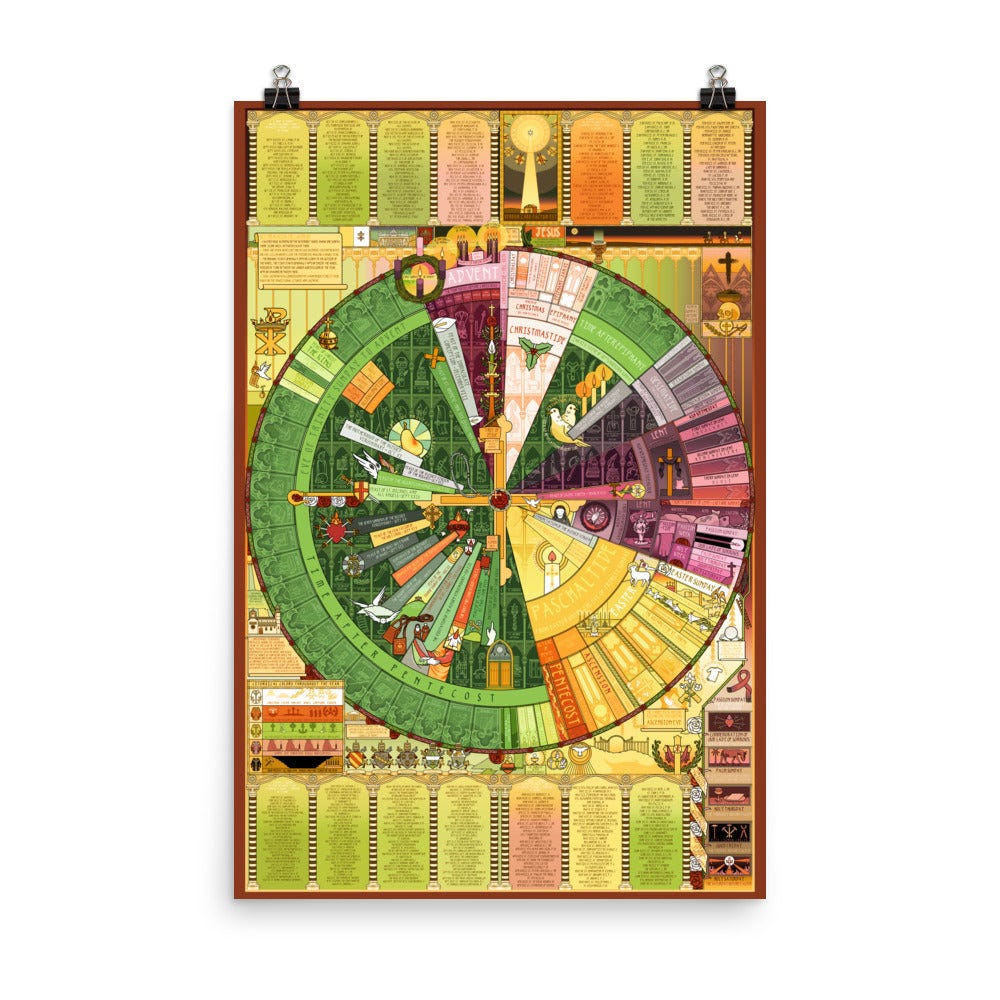
A simple rule, and one that is even still difficult to keep. Thrice daily4 we are called to turn our attention and our life to God through prayer. Say the morning, afternoon, and evening prayers to focus ourselves in a world of turmoil so that we may better engage with it. So that we remember our Lord God and may receive wisdom to act in such a way as to guide our lives, and the lives of those we are responsible toward Him.
On a slightly larger scale are the regular Wednesday and Friday fasts where the strict fast rules usually apply to draw our minds to the betrayal and crucifixion of Christ. They also serve to teach us about ourselves - are you able to go without alcohol two whole days a week? What about meat? Dairy?
The Church teaches us mediation: to celebrate, and to abstain from excess. The Church does so through the greater yearly calendar of feasts and fasts.
January 5th: The Eve of Theophany
December 25th: The nativity of our Lord Jesus Christ light in the darkness, express charity and hope
January 6th: Theophany/Epiphany - The Blessing of the Waters by Christ and the revelation that He is God together with the Father and the Holy Spirit as Christ blessed the waters we are blessed and intended to bless, that is make right and participate in the transformation of, the world
February 2nd: The Presentation of the Lord
March 25th: The Annunciation and celebration of the Theotokos’ willingness and special role in participating in the miraculous incarnation of God. Theanthropos eternal made manifest. If you ever wondered what image and likeness we are patterned after and why the universe makes sense to us it is because we are patterned after Christ Who Walked in Eden and Ate with Abraham in His Post-Resurrectional eternal body (mind bending)
Moving target relative to Pascha: Lent the great fast which prepares us and tests us in order to reveal to ourselves our shortcomings. It is not always the same shortcoming; and this is what the rules are meant to do.
Moving target relative to Pascha: Palm Sunday one week before Easter/Pascha
Moving target: Pascha the Conquering of Death by God, the greatest of celebrations for in it we remember and participate in the great Hope of Salvation
Moving target relative to Pascha: 40 days after Pascha comes the Ascension of Christ which reminds us that He is God and seated at the right hand of the Father. A claim of equality and power
Moving target: 50 days after Pascha comes Pentecost, the sending of the Holy Spirit upon the apostles and which reminds us of our own chrismation and the beginning of apostolic succession e.g., the Church
Moving target: Sunday after Pentecost is the Fast of the Apostles until June 29th and sometimes it’s one or two days and other times it feels like forever didn’t we just go through a major fast
June 29th: Feast of Saints Peter and Paul two key Saints in the Church who steadfastly served until martyrdom and Apostles both
August 1st-14th: Fast of the Theotokos as we prepare for the passing of the Theotokos
August 6th: Transfiguration - the revealing of the Divine Christ
August 15th: The Dormition of the Theotokos where we remember the mother Jesus Christ must have loved so
August 29th: The Beheading of St. John the Baptist who boldly readied the way for Jesus and whom Jesus knew. A martyr and example
September 15th: The Elevation of the Holy Cross
November 15th-December 24th: The Nativity Fast in anticipation of Our Lord’s incarnation
Note that the above is incomplete - name days and remembrances of Saints abound; every day has Saints attached to it and their lives are to be read from a Synaxarion (Lives of the Saints). The Church is constantly reminding us and bringing us back out of the world, if only we choose to participate; to teach us how we ought to be when we are in the world where most of us are most of the time.
Many will say this is unnecessary or cruel or or or, but the practical is that which we live and we have to live it first. We live every day in a superabundance of stuff, and we are always talking about and obsessing over our consumption. Maybe fasting is good, actually.
The hot button example is baptism for receiving converts into the Church. Online hardliners who may or may not even be Orthodox say it is an absolute requirement. How to explain St. Dismas? Are we binding and constraining God? It is better to say baptism is good for the person, and that if your bishop decides you are to be received some other way that you display obedience to the ecclesia rather than yourself. This is particularly important for Americans (I say this as an American who grew up Evangelical Nondenom and saw this happen) who are used to up and leaving to another church or founding a new church over the smallest differences.
Rest of World has their own calendars and their own histories for their people
This is America, after all
I reliably do this once a day because I am honestly not great at this
Though I am Lutheran, a part of me regrets the division of Christendom into the Catholic and Protestant spheres. There are enough great mysteries to ponder without having to wonder if works and a priesthood are necessary or not, for to the serious scholar of faith the two positions are irreconcilable.